What Is MMA Pavement Marking? (And Why Florida Projects Specify It)
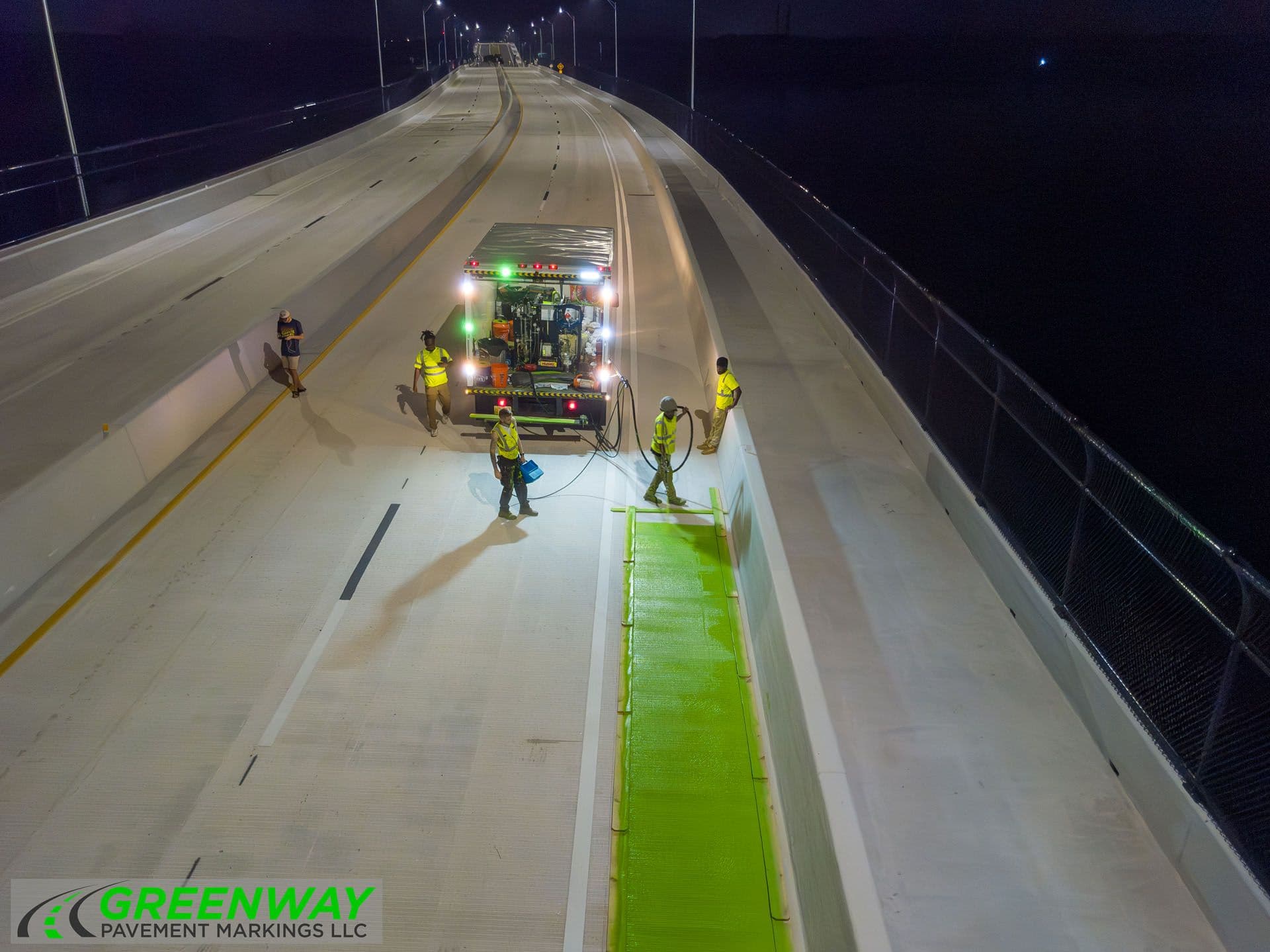

MMA — methyl methacrylate — is a two-component reactive resin pavement marking that cures at ambient temperature in 15 to 30 minutes and lasts 9 to 11 times as long as standard highway traffic paint, depending on traffic volume, surface conditions, and application environment. Unlike traffic paint, which air-dries, or thermoplastic, which must be applied molten at around 400°F, MMA cures through a chemical reaction between a liquid resin base and a catalyst applied at the spray tip. No heat source is required, which means it can be applied year-round in Florida and opened to traffic in under half an hour.
How Does MMA Differ from Thermoplastic and Traffic Paint?
Florida highway engineers and property managers choose from three primary pavement marking materials. Each carries different durability, application requirements, and cost profiles.
Traffic Paint (Waterborne Acrylic)
- Durability in Florida: 1–2 years on high-traffic roads; up to 3 years in lighter-traffic areas
- Application: Sprayed at ambient temperature; opens to traffic in 30–60 minutes depending on humidity
- Best for: Budget-driven projects, temporary markings, lower-traffic commercial parking lots
- Limitation: Acrylic polymer degrades quickly under Florida’s UV index of 10–11 (Extreme); glass beads sit on top of the film and are lost as it chalks
Thermoplastic
- Durability in Florida: 3–7 years, depending on traffic volume — shorter at high-wear intersections, longer on lightly traveled segments
- Application: Applied molten at 375–425°F; bonds to pavement as it cools
- Best for: State-maintained roadways, airport aprons, intersections requiring greater durability than paint
- Limitation: Requires specialized heating equipment; surface must be properly preheated; performance in Florida heat depends on asphalt surface temperature at application
MMA (Methyl Methacrylate)
- Durability: 9–11× longer than standard highway traffic paint, per performance data on Florida applications
- Application: Cold-applied; two components mix at the spray tip and cure in 15–30 minutes at Florida ambient temperatures
- Best for: High-wear intersections, crosswalks, bike lane conflict zones, stop bars, bus lanes, and any project requiring fast lane reopening
- Advantage over thermoplastic: No surface preheating required; faster lane reopen; wider temperature range for application
How Long Does MMA Pavement Marking Last?
MMA pavement markings last 9 to 11 times as long as standard highway traffic paint, depending on traffic volume, surface conditions, and application environment. On high-traffic Florida arterials where traffic paint requires annual or 18-month restriping, an MMA application in the same location may remain in compliance for close to a decade without reapplication.
Three material properties drive this longevity:
- Film thickness – MMA is applied at 60 to 120 mils wet-film thickness — substantially thicker than traffic paint at 15 to 18 mils — so there is more material mass before wear reaches the pavement.
- UV resistance – The cross-linked polymer film that forms during the chemical cure resists UV photodegradation far better than acrylic binders; Florida’s extreme UV does not chalk or fade MMA the way it destroys traffic paint within 12–18 months.
- Bead embedment – Glass beads are embedded throughout the cured film rather than sitting on a thin surface layer, so retroreflectivity is maintained as the marking wears down, not lost the moment the top film erodes.
Florida’s UV index regularly reaches 10–11 (Extreme) in summer, and winter UV in South Florida frequently reads 7–9 — among the highest sustained values in the continental United States. MMA’s UV-stable pigmentation is the single most important reason it outperforms traffic paint in this climate.
Why Is MMA on the FDOT Approved Products List?
The FDOT Approved Products List (APL) is maintained by the Florida Department of Transportation’s State Materials Office. A product earns APL inclusion only after passing a rigorous testing protocol that evaluates retroreflectivity, adhesion to asphalt and concrete, skid resistance, and chemical stability under Florida’s environmental conditions. FDOT does not certify contractors — it approves specific material products. Any contractor claiming to be “FDOT-certified” is using inaccurate language; the correct phrase is that they use FDOT-approved materials from the APL.
MMA products appear on the FDOT APL under Qualified Products Lists for pavement marking materials. These listings confirm that specific formulations have been independently tested and meet the performance requirements in Florida’s Standard Specifications for Road and Bridge Construction — including retroreflectivity minimums, durability targets, and skid resistance thresholds that state-funded projects require.
When Greenway Markings specifies MMA on a state-funded project, we use only APL-listed products. For bike lanes, bus lanes, crosswalks, and conflict zones, MMA’s anti-skid performance and color retention are the reasons it is specified rather than paint. For a full overview of what Greenway installs, see our MMA pavement markings service page.
What Is MMA Cure Time, and How Does It Enable Overnight Scheduling?
MMA cures in 15 to 30 minutes depending on temperature. At Florida’s typical ambient temperatures of 80–95°F, cure time is often toward the shorter end of that range. Thermoplastic requires a preheated asphalt surface before application; traffic paint requires 30–60 minutes minimum open time, often longer in Florida’s high humidity.
A typical overnight lane closure on a Florida DOT project runs from 10 PM to 5 AM — seven hours. In that window, crews can apply MMA stop bars, crosswalks, lane lines, and intersection markings, allow them to cure fully, and reopen the lane before morning rush hour with no wet-paint risk. Greenway schedules roadway marking work overnight and during off-hours to minimize disruption to the traveling public.
This fast cure time is the primary reason Florida highway contractors specify MMA for high-priority intersection markings rather than thermoplastic or paint. Premature traffic exposure to uncured paint embeds tire tracks, destroys retroreflectivity immediately, and often requires same-night reapplication at full cost. With MMA, that risk is eliminated.
Frequently Asked Questions About MMA Pavement Marking
Is MMA pavement marking the same as epoxy?
No. Both are two-component reactive resin systems, but they use different chemistries. Epoxy uses an amine-cured system that takes 1–4 hours to cure and is moisture-sensitive during application. MMA uses a peroxide catalyst to trigger free-radical polymerization, producing a harder, more UV-stable film that cures faster and bonds more aggressively to asphalt and concrete. Epoxy is well-suited to sheltered environments — covered parking structures, warehouse floors — where UV is not a factor. MMA is the preferred choice for exterior, UV-exposed road and infrastructure applications in Florida.
Does MMA cost more than thermoplastic or traffic paint?
MMA carries a higher upfront material and equipment cost than traffic paint or thermoplastic. However, because MMA lasts 9 to 11 times as long as traffic paint and significantly longer than thermoplastic in Florida conditions, the total cost over a 10-year project horizon is often lower when reapplication cycles, labor mobilization, and lane closure costs are counted. Evaluating materials on initial price alone consistently underestimates the lifecycle cost of paint.
Can MMA be applied in Florida’s summer heat?
Yes. MMA can be applied across a wide surface temperature range that comfortably covers Florida’s year-round conditions, including summer asphalt surface temperatures above 120°F. The catalyst-to-resin ratio is adjusted to control pot life at high temperatures, ensuring the material remains workable through the applicator before the cure reaction begins. Professional applicators monitor surface temperature with infrared thermometers and adjust mix ratios before each application run.
Does MMA require special equipment?
Yes. MMA requires two-component spray or extrusion equipment that keeps resin and catalyst in separate tanks and mixes them only at the spray tip. Premature mixing initiates the cure reaction in the tank and ruins the material. Greenway Markings operates spray-MMA equipment in-house for Florida roadway, bike lane, and commercial projects. Spray application delivers a more uniform finish and installs up to 10× faster than rolled application.
Is MMA available in colors other than white and yellow?
Yes. MMA is available in white, yellow, green (bike lane conflict zones), red (bus lanes and fire lanes), blue (ADA accessible markings), black (contrast and obliteration), and custom branded colors for private parking programs. All standard traffic colors are achievable with FDOT-approved pigment concentrations in the resin base. See our bike lane markings page for examples of green and colored MMA conflict zone surfacing.