Understanding Fire Lane Striping Requirements in Florida

For commercial property managers, facility directors, and HOA board members in Florida, navigating the maze of property compliance is a full-time job. Between ADA accessibility, stormwater management, and general maintenance, it is easy to overlook one of the most critical safety features on your property: fire lane striping.
Fire lanes are not merely decorative or suggestive. They are legally mandated, strictly enforced emergency access zones designed to save lives and protect property during critical incidents. Failing to maintain these markings doesn't just result in steep fines from local fire marshals—it exposes property owners to devastating legal liability if emergency responders are delayed by illegally parked vehicles.
In this comprehensive guide, we will break down the exact fire lane striping requirements in Florida, exploring the state codes, local variations, precise measurement specifications, and the true cost of non-compliance.
The Foundation: Florida Fire Prevention Code (FFPC)
The primary governing document for fire safety in the state is the Florida Fire Prevention Code (FFPC)Official Florida State Fire Marshal Code, which is adopted and enforced by the State Fire Marshal. The FFPC incorporates national standards, primarily those set by the National Fire Protection Association (NFPA), specifically NFPA 1 (Fire Code) and NFPA 101 (Life Safety Code).
Under the FFPC, any commercial property—including retail centers, apartment complexes, industrial parks, and educational facilities—must provide and maintain unobstructed access for fire apparatus. This means fire trucks, ambulances, and rescue vehicles must be able to navigate the property, stage near buildings, and deploy equipment without interference.
The FFPC is updated every three years. Relying on striping specifications from a decade ago can leave your property out of compliance during your next inspection.
What Constitutes a Fire Apparatus Access Road?
According to the code, a fire apparatus access road (which encompasses designated fire lanes) must meet specific dimensional requirements:
- Unobstructed Width: A minimum of 20 feet of clear width is required. This is non-negotiable. If parking reduces the drivable width below 20 feet, parking must be restricted on one or both sides of the roadway.
- Vertical Clearance: There must be an unobstructed vertical clearance of at least 13 feet, 6 inches to accommodate the height of modern fire engines and ladder trucks.
- Turning Radius: The required turning radius is determined by the local fire department to ensure their specific vehicles can navigate the property safely.
Precise Striping Specifications: Getting the Details Right
While the FFPC provides the framework, the actual visual requirements for fire lanes—how they are painted and marked—are incredibly specific to ensure universal recognition. A hastily painted yellow curb with a 'No Parking' sign bought at a hardware store will almost certainly fail inspection.
1. The Color Requirement: Traffic Red
Fire lanes must be painted in a highly visible, specific shade of red, universally recognized as 'Traffic Red' or 'Fire Engine Red.' Using standard yellow (which indicates general no-parking or loading zones) or white is unacceptable. The paint must be a durable, traffic-grade material—such as chlorinated rubberA durable binder used in traffic paints or high-build acrylic—that can withstand Florida's intense UV radiation, heavy rainfall, and constant vehicular traffic without rapidly fading.
Florida's intense sun can bleach standard paints in a matter of months. Always ensure your striping contractor uses UV-resistant, traffic-grade coatings specifically formulated for high-sun environments.
2. Curb and Surface Painting
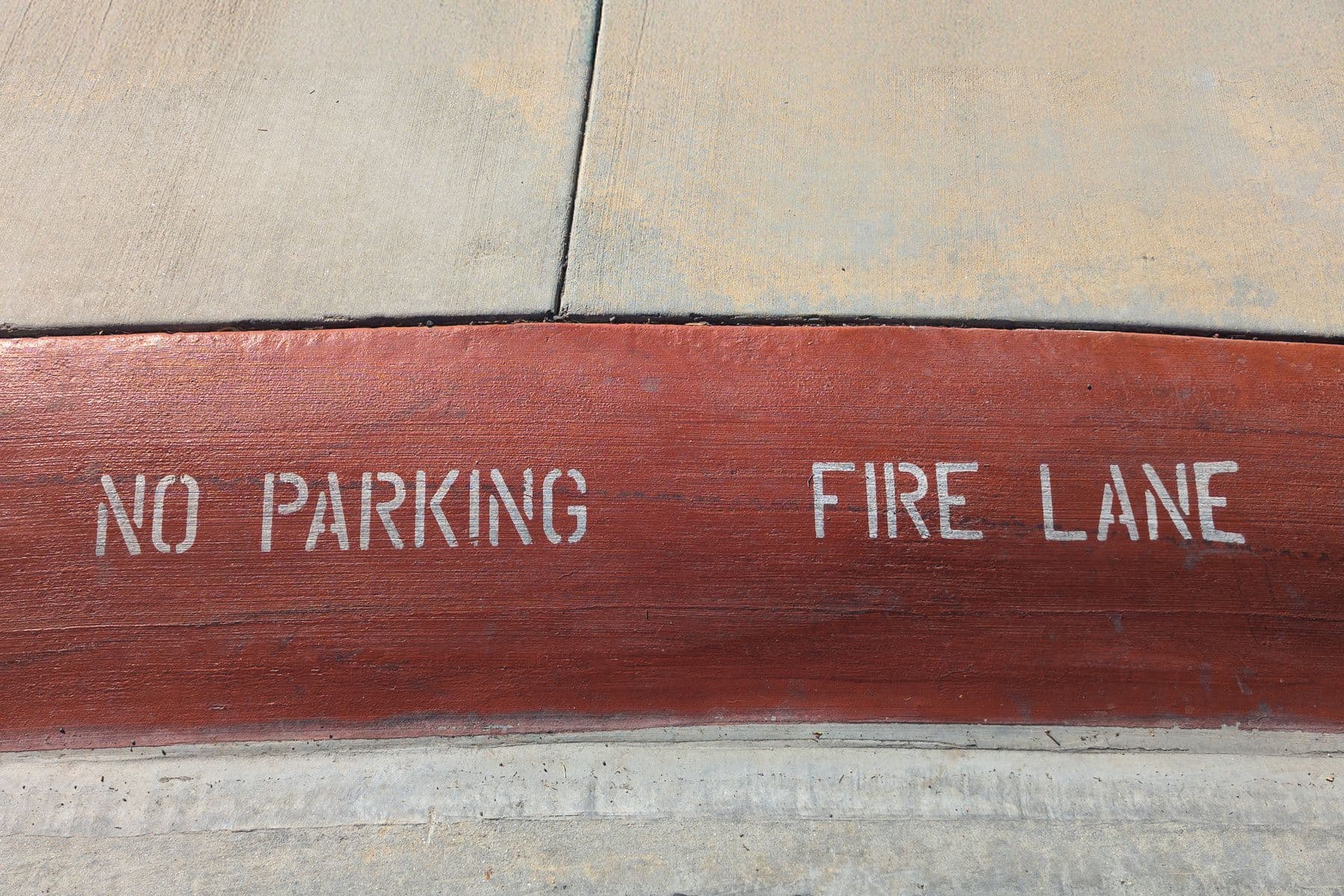
If the fire lane runs adjacent to a curb, the entire face and top of the curb must be painted red. If there is no curb, or if the fire lane extends across a flat paved surface, a continuous red stripe (typically 4 to 6 inches wide) must be painted on the pavement to delineate the boundary of the restricted zone.
3. Stenciled Lettering and Verbiage
The visual warning must be explicit and unmistakable. The words 'NO PARKING FIRE LANE' must be stenciled over the red background. The specifications for this text are strict:
- Color: The text must be painted in bright, contrasting white.
- Size: The letters must be a minimum of 4 inches tall, though many local jurisdictions require 6-inch or even 12-inch lettering for maximum visibility.
- Stroke: The stroke width of the letters is typically mandated to be at least 3/4 of an inch.
- Spacing: The message 'NO PARKING FIRE LANE' cannot just be painted once. It must be repeated at regular intervals. The standard is typically every 30 to 50 feet along the entire length of the designated fire lane.
The AHJ Factor: Local Variations Across Florida
One of the most complex aspects of property compliance in Florida is understanding the role of the Authority Having Jurisdiction (AHJ)The local governmental agency responsible for enforcing codes. While the FFPC sets the state-wide baseline, the local AHJ (usually the municipal or county Fire Marshal) has the authority to implement stricter regulations.
This means that a fire lane that passes inspection in Orlando might fail in Miami or Tampa. For example:
- Miami-Dade County: Often requires highly specific signage in addition to curb striping, including specific metal gauges and reflective backing for signs.
- City of Tampa: May enforce strict 12-inch lettering requirements on flat pavement fire lanes and require specific diagonal hatching to indicate staging areas.
- Orange County: Has detailed requirements regarding the placement of fire hydrants within these lanes and the specific striping clearances required around them.
In my 15 years working across Florida, I've seen countless property managers get fined because a national contractor used a generic 'state standard' that didn't meet the local AHJ's stricter requirements. Always hire a local expert who knows your specific Fire Marshal's preferences.
Signage Requirements: The Essential Partner to Striping
Striping alone is rarely sufficient. The FFPC and local codes require accompanying vertical signage to ensure the restriction is visible even if the pavement is obscured by standing water, debris, or a parked vehicle. Fire lane signs must conform to the Manual on Uniform Traffic Control Devices (MUTCD) standards:
- Design: Signs are typically 12 inches wide by 18 inches tall.
- Colors: They must feature a white reflective background with red lettering and a red border.
- Placement: Signs must be installed at the beginning and end of the fire lane, and spaced no further than 50 feet apart along the entire route.
- Height: The bottom of the sign should be mounted exactly 7 feet above the grade of the pavement to ensure it is visible over standard passenger vehicles.
The True Cost of Non-Compliance
Treating fire lane striping as an afterthought is a dangerous financial and legal gamble for property owners.
1. Municipal Fines and Citations
Fire Marshals conduct routine, unannounced inspections of commercial properties. If your fire lanes are faded, incorrectly colored, missing stencils, or lacking proper signage, you will receive a citation. While initial warnings may give you 30 days to rectify the issue, failure to comply quickly leads to escalating fines that can reach hundreds of dollars per day per violation.
2. The Inability to Tow Violators
Property managers frequently struggle with tenants or visitors parking in fire lanes. However, under Florida law, towing companies cannot legally remove a vehicle from a fire lane if the lane is not properly and legally marked. If your red paint is faded or your signs are missing, you lose your ability to enforce the rules, leading to chronic illegal parking and blocked emergency routes.
3. Catastrophic Legal Liability
This is the most severe risk. In the event of a fire, medical emergency, or active threat, every second counts. If a fire engine or ambulance is delayed because a delivery truck parked in an unmarked or poorly marked fire lane, the property owner can be held entirely liable for the resulting property damage, injuries, or loss of life. Juries historically show zero leniency to property owners who demonstrate gross negligenceA conscious and voluntary disregard of the need to use reasonable care regarding life safety codes.
ADA Compliance vs. Fire Lane Compliance
A common challenge in parking lot design is managing the intersection of ADA (Americans with Disabilities Act) requirements and fire codes. Often, accessible parking spaces and their associated access aisles are located near building entrances—the exact areas that fire departments need clear for staging.
It is critical to understand that fire lanes take precedence over parking convenience. You cannot legally designate an ADA parking space if it encroaches upon the required 20-foot unobstructed width of a fire apparatus access road. Furthermore, ADA access aisles (the hatched areas next to accessible spots) cannot double as fire lanes. These systems must be designed cohesively, requiring the expertise of a striping professional who understands both federal ADA law and local fire codes.
Why Professional Application Matters
Maintaining fire lanes is not a DIY job for the property's maintenance staff. It requires:
- Code Knowledge: Ensuring the exact shade of red, the precise stroke width of the stencil, and the correct spacing of signs.
- Surface Preparation: Paint applied over dirty, oily, or flaking asphalt will peel off within weeks. Professional contractors pressure wash, sweep, and prepare the surface to ensure the traffic paint bonds molecularly with the pavement.
- Specialized Equipment: High-pressure airless striping machines are required to apply the thick, even coats of high-build traffic paint necessary for longevity and immediate reflectivity.
Conclusion
Clear, compliant fire lane striping is a fundamental pillar of property management and life safety in Florida. By understanding the state codes, respecting the authority of your local Fire Marshal, and maintaining your markings proactively, you protect your property from fines, shield yourself from liability, and—most importantly—ensure that first responders can do their jobs when seconds matter most.
Don't wait for a failed inspection or a tragedy to update your markings. If your red curbs are fading to pink, or if your stencils are illegible, it is time to act.
Need to bring your property up to code? Greenway Markings specializes in AHJ-compliant fire lane striping across Florida. Contact our sales team today for a free, no-obligation site assessment and estimate.