How Long Do Pavement Markings Last in Florida?
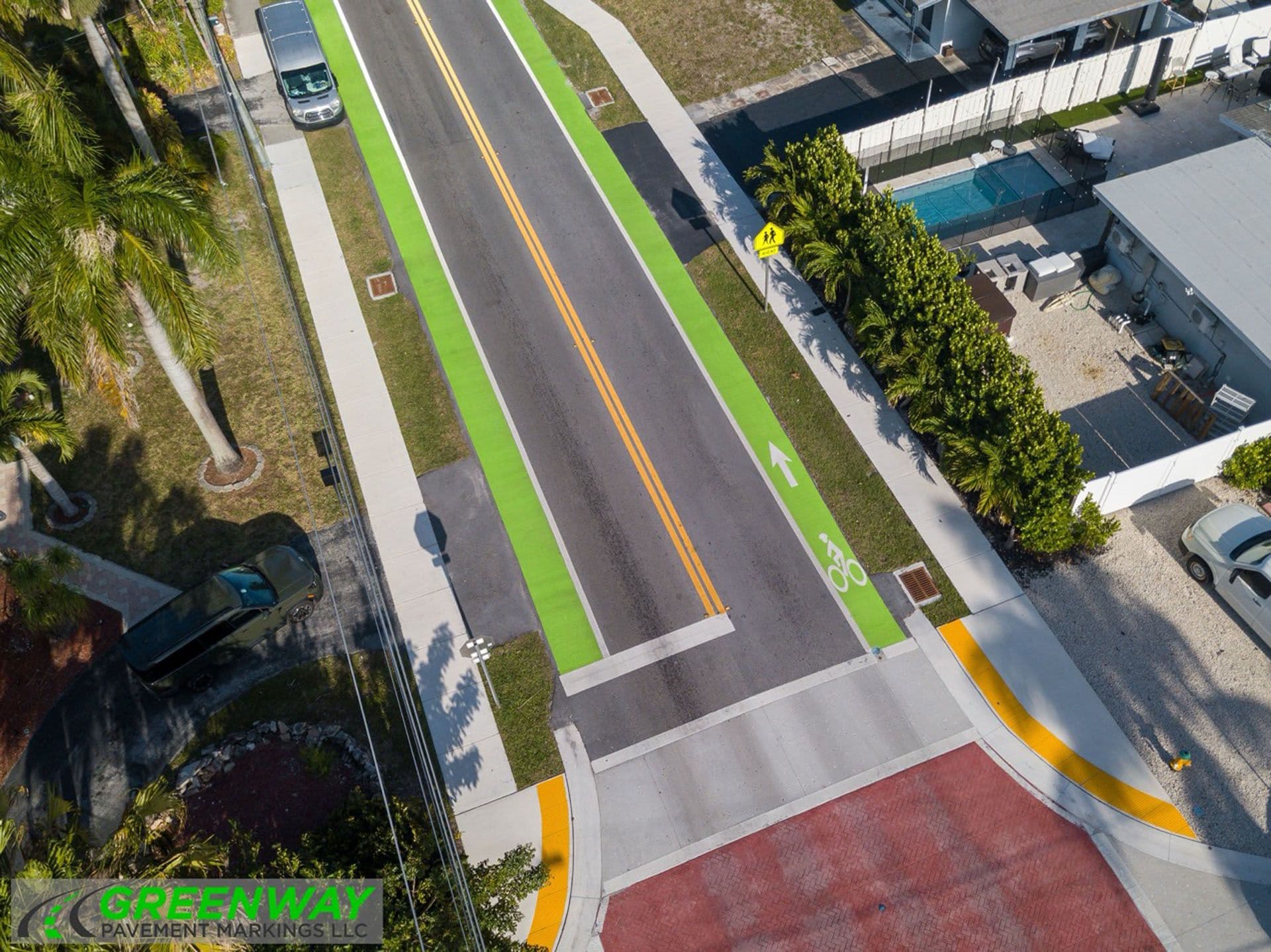

In Florida, traffic paint lasts 1 to 2 years on active roads before fading below usable retroreflectivity. Thermoplastic lasts 3 to 7 years depending on traffic volume. MMA (methyl methacrylate) lasts 9 to 11 times as long as standard highway traffic paint, depending on traffic volume, surface conditions, and application environment. These numbers run shorter than national averages because Florida’s extreme UV index, sustained heat, and heavy summer rainfall degrade pavement marking materials faster than almost any other climate in the continental United States.
How Long Does Each Type of Pavement Marking Last in Florida?
Every pavement marking degrades through the same mechanisms: UV photodegradation breaks down the binder and pigment; mechanical wear from vehicle tires abrades the surface film; thermal cycling from Florida’s day-night temperature swings causes micro-cracking and delamination. The rate at which this happens determines effective service life.
Traffic Paint: 1–2 Years in Florida
Waterborne acrylic traffic paint is the lowest-cost marking material and the shortest-lived in Florida. Applied at 15–18 mils, it air-dries to a surface film. The acrylic polymer is not UV-stabilized for extended outdoor exposure, and Florida’s UV index of 10–11 (Extreme) causes chalking and visible fading within 12 months on exposed roadways. Glass beads — which provide nighttime retroreflectivity — sit on top of the paint film and are lost as the film erodes. Retroreflectivity often drops below safe nighttime thresholds before the marking looks visibly faded in daylight. Annual or 18-month restriping cycles are standard on high-traffic Florida roads using traffic paint.
Thermoplastic: 3–7 Years in Florida
Thermoplastic is applied molten at 375–425°F and bonds to pavement as it solidifies at a thickness of 90–125 mils — substantially thicker than traffic paint. Glass beads are both surface-dropped and pre-blended into the material so retroreflectivity is partially maintained as the surface wears. On Florida DOT primary arterials, thermoplastic typically lasts 3 to 5 years at stop bars and intersection markings — the highest wear zones — and up to 7 years on lightly trafficked segments. See Greenway’s roadway markings service for where thermoplastic fits in a project scope.
MMA (Methyl Methacrylate): 9–11× Longer Than Traffic Paint
MMA outperforms both traffic paint and thermoplastic in Florida conditions. Its cross-linked polymer film resists UV photodegradation at a chemical level — Florida’s extreme sun does not chalk or fade MMA the way it destroys acrylic paint films. Applied at 60–120 mils, MMA maintains its film mass and embedded glass bead population far longer, sustaining retroreflectivity across the full service life. For high-wear intersections or bike lane conflict zones where traffic paint requires annual restriping, MMA typically requires no reapplication for close to a decade. See the full profile on our MMA pavement markings page.
Epoxy: Strong Indoors, Limited UV Performance Outdoors
Epoxy pavement markings use a two-component amine-cured system. They are chemically resistant and durable, but the UV performance of epoxy in exterior Florida applications is inferior to MMA — epoxy can yellow under prolonged UV exposure, undermining white line visibility. Epoxy performs well in shaded or covered environments such as parking structures and warehouse floors where UV is not a factor. For outdoor Florida applications requiring maximum service life, MMA is preferred over epoxy.
How Does Florida’s UV and Heat Shorten Pavement Marking Life?
Florida’s UV is the primary environmental accelerant. The state consistently records UV index values of 10–11 (Extreme) during summer months, and winter UV in South Florida frequently reaches 7–9. This means Florida pavement markings absorb roughly 30–40% more annual UV radiation than identical markings in northern US climates.
UV radiation breaks down polymer binders through photodegradation: UV photons break the polymer chain bonds holding the marking film together, causing the material to chalk, crack, and lose cohesion. The pigment molecules that give markings their visibility are also UV-sensitive — titanium dioxide (white) and organic pigments (yellow) can shift, fade, or lose luminance under sustained UV exposure even when the film appears physically intact.
Asphalt surface temperatures in Florida regularly reach 140–160°F in direct summer sun. At these temperatures, thermoplastic markings soften and become susceptible to tire tracking — wheel loads deform the softened material, and hot tires can peel or lift it from the substrate. Florida’s average annual rainfall of 54 inches statewide adds hydraulic erosion on top of UV and thermal damage: heavy summer downpours create sheet flow that scours marking edges, and repeated wet-dry cycles accelerate micro-cracking in the film.
How Does Traffic Volume Affect Pavement Marking Lifespan?
Traffic volume is the second major lifespan factor after UV. A stop bar at a signalized intersection on a 50,000 Average Daily Traffic (ADT) corridor in Tampa experiences far more mechanical wear than the same marking on a 5,000 ADT county road. Stop bars and crosswalk lines at signalized intersections are the most demanding locations because vehicles both decelerate onto and accelerate off of them — braking and acceleration create higher tire-to-pavement shear forces than constant-speed travel. This is why FDOT engineers specify MMA preferentially at intersections rather than the thermoplastic used for lane lines.
Surface preparation before application also significantly affects how long a marking lasts. Markings applied to contaminated, wet, or structurally compromised asphalt will delaminate early regardless of material quality. Proper surface cleaning — and for MMA, mechanical preparation in some cases — is required to achieve full adhesion and the material’s rated service life.
How Often Should Commercial Parking Lots Be Restriped in Florida?
Most commercial parking lots should be restriped every 12 to 24 months, depending on traffic volume, sun exposure, and pavement condition. High-traffic retail lots often need annual restripes; lower-traffic office parks can go up to 2 years. This is a shorter cycle than many property managers budget for, because Florida’s UV degrades traffic paint faster than in northern climates. See Greenway’s parking lot striping service for information on commercial restriping.
ADA-compliant stall markings warrant particular attention: faded accessible stall lines, faded ISA (wheelchair) stencils, or missing access aisle markings create both a compliance gap and liability exposure. Federal ADA standards (28 CFR Part 36) require 1 accessible space per 25 total spaces for lots with up to 100 spaces, with at least 1 van-accessible space per 6 accessible spaces. When those markings fade below legibility, the space loses its accessible designation in practical terms. See our ADA compliance service for accessible stall standards.
What Are the Signs That Pavement Markings Need Replacement?
- Retroreflectivity below minimum: Markings on high-speed roads must meet federal minimum in-service retroreflectivity thresholds — 100 mcd/lux/m² for white and 75 mcd/lux/m² for yellow on roads posted 45 mph or above (per FHWA 23 CFR Part 655). A marking can drop below this threshold while still appearing visible in daylight.
- Visible width reduction: When a 4-inch lane line has worn to 3 inches or narrower, it has lost meaningful lane-guidance function.
- Cracking, peeling, or delamination: Surface cracking in thermoplastic or MMA allows water to infiltrate under the marking edge, accelerating delamination during Florida’s wet-dry cycles.
- Loss of daylight contrast: A marking indistinguishable from the surrounding pavement in daylight is functionally invisible in rain, where windshield water film further reduces contrast.
- ADA contrast failure: Faded blue ISA stencils or white access aisle markings may no longer meet ADA contrast requirements even while partially visible, creating compliance exposure for the property owner.
Frequently Asked Questions About Pavement Marking Durability
Do Florida DOT roads have minimum retroreflectivity requirements for pavement markings?
Yes. FDOT-maintained roads are subject to FHWA’s minimum in-service retroreflectivity requirements under 23 CFR Part 655. For roads posted 45 mph or above — which covers most state arterials — white markings must maintain a minimum of 100 mcd/lux/m² and yellow markings a minimum of 75 mcd/lux/m² in service. When markings drop below these thresholds, FDOT’s pavement marking management program schedules restriping. New installations are applied at substantially higher initial values to allow for degradation over the service life.
Why do commercial parking lot markings fade faster than road markings in Florida?
Two factors compound each other. First, parking lots use traffic paint almost exclusively rather than the thermoplastic or MMA found on state roads, because paint is the lowest upfront cost and parking lot maintenance budgets are managed by property owners rather than state DOT capital programs. Second, parking lots typically lack scheduled inspection programs, so faded markings go longer without replacement than FDOT-monitored road markings. The result is that a commercial lot striped three years ago with traffic paint in South Florida is almost certainly operating with markings that have degraded below useful function.
Can you apply new pavement markings over old faded ones?
In some cases yes — but it requires a condition assessment first. For traffic paint over traffic paint, the existing surface must be sound, clean, and free of loose material, oil, and wax. Applying over a severely chalked or delaminating film yields poor adhesion and short life for the new application. For thermoplastic over thermoplastic, overstriping is standard practice on maintenance projects when the existing material is still bonded. For MMA, substrate compatibility should be verified, as MMA applied over certain incompatible existing materials may not achieve full bond strength without mechanical surface preparation.
What is retroreflectivity, and why does it matter more than how a marking looks in daylight?
Retroreflectivity is a surface’s ability to reflect light back toward its source. In pavement markings, a driver’s headlights are retroreflected back to the driver’s eyes at night and in rain. It is measured in millicandelas per lux per square meter (mcd/lux/m²). A marking can appear acceptable in daylight while its glass bead population has eroded to the point where nighttime and wet-weather visibility is critically compromised. Retroreflectivity measurement — not visual inspection — is the correct standard for determining when markings need replacement. This is why FDOT uses mobile retroreflectometers for statewide marking condition assessments rather than visual survey crews.
When is the best time of year to restripe pavement in Florida?
Florida allows pavement marking application year-round, unlike northern states where winter temperatures prevent application. The most favorable conditions are the dry season months of November through April, when ambient temperatures are moderate (65–85°F), humidity is lower, and afternoon thunderstorm probability is minimal. Traffic paint and thermoplastic are most reliably applied in these conditions. MMA is more temperature-tolerant and can be applied effectively year-round with proper catalyst adjustment, making it a strong choice for projects with summer construction schedules. Greenway schedules work overnight and during off-hours regardless of season to minimize disruption.